
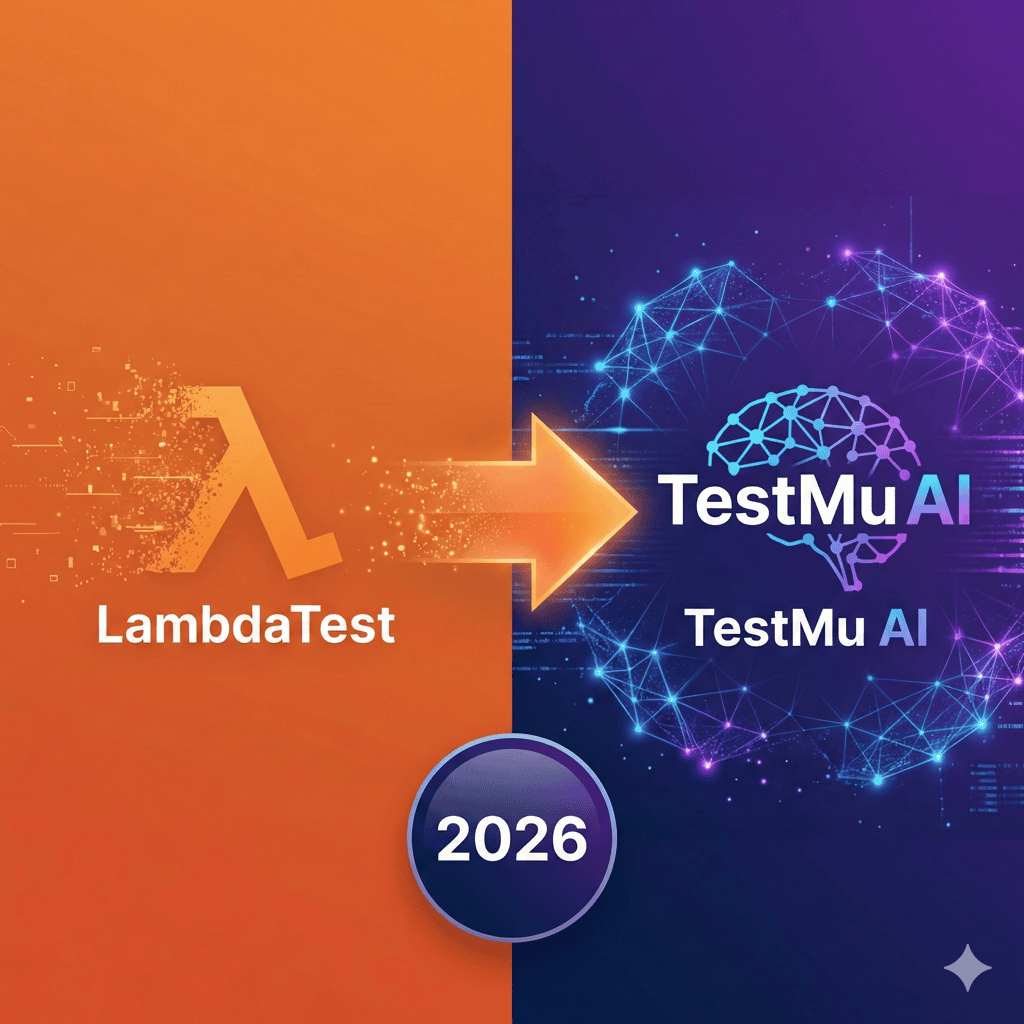
If you woke up this morning wondering what happened to LambdaTest, you’re not alone.
On January 12, 2026, LambdaTest officially rebranded to TestMu AI, positioning itself as “the world’s first Agentic AI Quality Engineering platform.”
Let’s cut through the marketing and look at what actually changed — and more importantly, what didn’t.
What’s New With TestMu AI
The rebrand comes with substantive product developments — this isn’t just marketing.
KaneAI: The GenAI-Native Test Agent
KaneAI is TestMu AI’s flagship AI feature, and it’s genuinely useful:
Natural Language Test Creation: Write tests in plain English. “Test the checkout flow with an expired credit card” becomes executable test code.
Multi-Language Code Export: KaneAI generates tests in your framework of choice — Selenium, Playwright, Appium, XCUITest. Not locked into proprietary formats.
2-Way Editing: Switch between natural language view and code view. Changes sync automatically. Edit in whichever mode you prefer.
Auto-Healing Tests: When UI elements change, KaneAI attempts to adapt locators automatically. Reduces maintenance burden.
Smart Test Planner: Give high-level objectives, get detailed test steps. Useful for coverage expansion.
Integrations: Tag @KaneAI in Jira tickets, Slack, or GitHub Issues to trigger test automation directly.
Agent-to-Agent Testing
A new capability for testing AI agents using AI agents. As more products embed AI, this addresses a real gap — how do you test unpredictable AI responses at scale?
Analyst Recognition
- Gartner Magic Quadrant 2025 for AI-Augmented Software Testing Tools (Challenger position)
- Forrester Wave: Autonomous Testing Platforms 2025
“Vibe Testing”
Yes, that’s their actual term. It targets “vibe coders” — developers using AI to generate code rapidly. The pitch: if AI writes your code, AI should write your tests too.
What Hasn’t Changed
Here’s where it gets important. Despite real AI features, the fundamental architecture remains the same:
Your Binaries Still Upload to Their Cloud
TestMu AI is still a cloud-based device farm. When you run tests:
- Your app binary uploads to their servers
- Tests execute on their hosted devices
- Results stream back over the internet
KaneAI helps you write tests faster. It doesn’t change where those tests run.
Network Latency Is Still 100-500ms
AI doesn’t change physics. Your test commands still travel:
Your CI → Internet → TestMu AI servers → Device → Back
That round-trip adds 100-500ms latency per interaction. Compare that to <50ms on local devices. KaneAI’s auto-healing and smart locators help with reliability, but not speed.
Pricing Structure Unchanged
TestMu AI’s mobile testing pricing mirrors LambdaTest’s:
| Tier | Price | What You Get |
|---|---|---|
| Native App Automation | $159/mo per parallel | Real device app testing (Appium, Espresso, XCUITest) |
| HyperExecute | $159/mo per license | Fast test orchestration |
KaneAI appears to be bundled into existing tiers, not a separate add-on (yet).
Third-Party Data Exposure Remains
If you’re in fintech, healthcare, or any regulated industry, the compliance question hasn’t changed:
- Your test data routes through third-party infrastructure
- Binary artifacts are stored on their servers
- You’re still reliant on their security certifications (SOC2, etc.)
KaneAI doesn’t change data residency.
The “Agentic AI” Reality Check
Let’s be fair about what KaneAI and “agentic AI” actually deliver:
What it genuinely does well:
- Generates test code from natural language (real time-saver)
- Exports to multiple frameworks (not vendor lock-in)
- Auto-heals broken locators (reduces maintenance)
- Integrates with your workflow tools (Jira, Slack, GitHub)
- Provides assisted debugging with root cause analysis
What it doesn’t change:
- Where your binaries physically run (still their cloud)
- Network latency for test execution (still 100-500ms)
- Data residency and compliance posture (still third-party)
- Fundamental cost structure (still per-parallel pricing)
Bottom line: KaneAI is a legitimate productivity tool for test authoring. It can meaningfully speed up writing tests and reduce maintenance overhead. But it doesn’t address test execution concerns — latency, data exposure, or cost at scale.
If your bottleneck is writing tests, KaneAI helps.
If your bottleneck is running them fast and securely, the rebrand changes nothing.
What This Means For Your Strategy
If You’re Happy With LambdaTest
Nothing urgent. Your tests work, integrations stay intact. Explore the new AI features when you have time.
If You Were Already Questioning LambdaTest
A rebrand is a good trigger to reevaluate. Questions to ask:
- Latency: Is 100-500ms acceptable for your test suite?
- Cost: At $159/mo per parallel (scaling to $30K+/mo enterprise), what’s your annual spend?
- Security: Where does your binary go? Who has access?
- Control: Do you own your test infrastructure?
If You’re Evaluating Alternatives
The rebrand doesn’t change the competitive landscape. Your options remain:
| Approach | Latency | Binary Location | Monthly Cost |
|---|---|---|---|
| TestMu AI (LambdaTest) | 100-500ms | Their cloud | $159/parallel |
| BrowserStack | 100-500ms | Their cloud | $199/parallel |
| AWS Device Farm | 100-500ms | AWS | $0.17/minute |
| Own Devices + DeviceLab | <50ms | Your premises | $99/device |
The Bigger Picture
LambdaTest → TestMu AI follows a pattern in testing tools: every vendor is racing to add “AI” to their positioning.
But the fundamentals of mobile testing haven’t changed:
- Tests need devices
- Devices need infrastructure
- Infrastructure has latency and security tradeoffs
AI can help you write tests faster. It can’t eliminate the physics of where those tests run.
Our Take
Rebrands create confusion. Confusion creates an opportunity to step back and ask: Is this actually working for us?
If cloud latency, third-party data exposure, or per-parallel pricing were pain points before, they’re still pain points now — regardless of how many times “AI” appears in the marketing.
At DeviceLab, we took a different approach: your devices, your network, your control. Tests stream directly to devices you own via peer-to-peer WebRTC. No binary uploads. No third-party exposure. Sub-50ms latency.
AI is great for writing tests. But when it’s time to run them, physics still matters.
Frequently Asked Questions
Is TestMu AI the same as LambdaTest?
Yes. TestMu AI is LambdaTest’s new name as of January 2026. The platform, pricing, and core architecture remain the same.
Why did LambdaTest rebrand to TestMu AI?
LambdaTest rebranded to position itself as an ‘Agentic AI Quality Engineering’ platform, emphasizing AI-driven test automation capabilities.
Will my LambdaTest tests still work?
Yes. Existing integrations, tests, and workflows should continue working. The rebrand is primarily a naming and positioning change.
Did TestMu AI pricing change from LambdaTest?
As of the rebrand announcement, pricing remains the same. Native App Automation starts at $159/mo per parallel test. Enterprise deals typically run $30,000+/month.
What is ‘vibe testing’ that TestMu AI mentions?
Vibe testing is TestMu AI’s marketing term for AI-assisted test generation using natural language prompts. It’s a positioning concept, not a fundamentally new technology.
Evaluating your testing infrastructure? See how DeviceLab compares or get started in 10 minutes.