
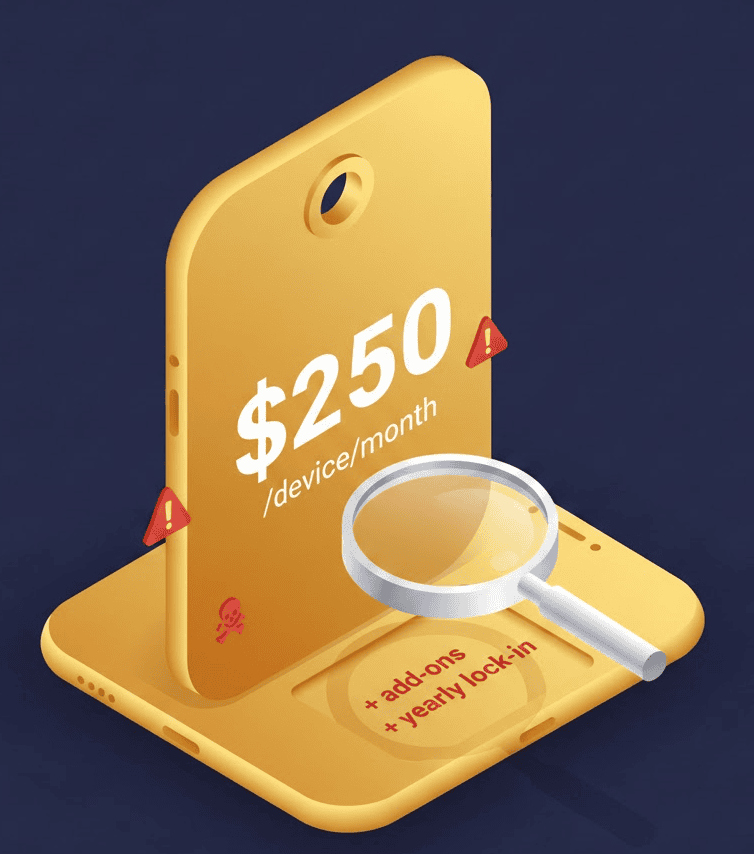
HeadSpin pricing looks affordable at first—CloudTest Lite starts at just $49/month. But what does that entry price actually include?
One user. 40 hours per month. Manual testing only. No automation, no screen recording, no device logs, no CI/CD integration, no analytics.
The real HeadSpin—the one with automation, performance metrics, and the AI-powered insights they market—costs significantly more. How much more? Let’s look at what actual enterprise customers are paying.
How Much Does HeadSpin Actually Cost?
The gap between HeadSpin’s advertised pricing and what enterprises actually pay is substantial. Let’s break down the real numbers.
The Enterprise Reality: $42,000-$48,000/Year
A Senior Manager at Games24x7 disclosed their HeadSpin costs on PeerSpot:
“We have a yearly license for 16 devices costing 35-40 lakhs in rupees.”
That’s approximately $42,000-$48,000 USD per year. For 16 devices.
Breaking it down:
- Per device per year: $2,625-$3,000
- Per device per month: $219-$251
At $250/device/month, HeadSpin costs more than double what BrowserStack charges and nearly triple LambdaTest’s enterprise rates.
The Add-On Tax
HeadSpin’s tiered pricing obscures the true cost through a complex add-on structure. Here’s what each tier actually includes—and what requires additional purchases:
CloudTest Lite ($49/month)
- 1 user, 40 hours/month
- Manual testing only
- 30-day data retention
- Missing: automation, screen recording, device logs, CI/CD, app management, all KPIs and analytics
CloudTest Go ($300/month base)
Still requires add-ons for:
- Automation+ (for automated testing)
- Experience+ (for dashboards and KPIs)
- Performance+ (device and network metrics)
CloudTest Pro (Custom pricing)
Includes everything, but requires:
- Yearly commitment
- Custom negotiation
- Additional add-ons for media testing and monitoring
The pattern is clear: the advertised price is the entry fee. The features you actually need cost extra.
What Users Actually Say
Reviews across G2, Capterra, PeerSpot, and TrustRadius reveal consistent frustrations:
On pricing:
“Cost to value is unreasonable. Having a strong partnership program with SIs would help.”
— Software Advice review
“Pricing is too high for small companies… I want them to lower the pricing so that small businesses can also use it.”
— TrustRadius review
“It is expensive. There are a lot of other cheaper players in the market, but it is like a Mercedes. You pay an extra premium for it.”
— PeerSpot review
On licensing inflexibility:
“It has a yearly license. There is no other option.”
— PeerSpot review
“I would love to see them come up with project-based costing. Companies that are low on funds or new-age can do with pricing that is easily digestible.”
— PeerSpot review
On performance (despite premium pricing):
“First of all, it’s very laggy. Not with the UI, but when you interact with the remote devices, I think the latency is seven to nine seconds. That means that there is a seven- to nine-second delay on average when you click on certain things.”
— PeerSpot review
Seven to nine seconds of latency. At $250/device/month.
The Fraud Factor
Before committing to a premium-priced vendor, enterprises should understand HeadSpin’s recent history.
In 2019, HeadSpin achieved “unicorn” status with a $1.1 billion valuation. In May 2020, an internal investigation revealed that co-founder and CEO Manish Lachwani had been inflating revenue figures—claiming $95.3 million when actual revenue was $26.3 million.
The aftermath:
- Valuation crashed: $1.1 billion → $300 million (73% drop)
- SEC charges: Fraud for misleading investors out of $80 million
- DOJ charges: Wire fraud and securities fraud
- Sentence: 18 months in prison (April 2024)
HeadSpin has since implemented remedial measures—new management, expanded board, investor repayments. But the episode raises questions about paying premium prices to a company that inflated its own metrics by 3.6x.
Competitor Pricing Comparison
How does HeadSpin stack up against alternatives?
| Platform | Entry Price | Enterprise (Est.) | Per Device/Month |
|---|---|---|---|
| HeadSpin | $49/mo (limited) | $42,000-$48,000/yr | $219-$251 |
| Perfecto | $300/mo | $15,000-$100,000/yr | $125-$300 |
| BrowserStack | $39/mo | $2,400-$6,000/yr | $29-$99 |
| LambdaTest | $15/mo | $1,800-$4,800/yr | $15-$79 |
| Sauce Labs | Variable | Variable | $50-$150 |
| DeviceLab | $99/device/mo | Same | $99 |
HeadSpin costs 2-5x more than comparable platforms. The question is whether the premium delivers proportional value.
For a detailed cost analysis across all platforms, see our device cloud cost calculator.
When HeadSpin Makes Sense
HeadSpin isn’t overpriced for everyone. The platform excels in specific scenarios:
OTT and streaming testing: HeadSpin’s audio/video quality metrics (VMAF, MOS scores) are genuinely differentiated. If you’re testing Netflix-style streaming apps, these capabilities justify premium pricing.
Telco-specific needs: SIM-enabled devices across 50+ countries with real carrier network testing is valuable for telecom companies.
Global performance benchmarking: If you need to compare app performance across Mumbai, São Paulo, and Tokyo on actual carrier networks, HeadSpin’s infrastructure is hard to replicate.
Budget-flexible enterprises: Large companies with generous QA budgets who prioritize vendor consolidation may find value in HeadSpin’s all-in-one platform.
When HeadSpin Doesn’t Make Sense
For most mobile testing scenarios, HeadSpin’s pricing is difficult to justify:
Functional testing: If you’re running Appium or Espresso tests to verify your app works correctly, you don’t need $250/device analytics. BrowserStack and LambdaTest deliver the same test execution at 50-80% lower cost.
Startup and mid-market teams: Yearly-only licensing with no project-based options excludes teams with variable testing needs or budget constraints.
Privacy-conscious organizations: HeadSpin’s cloud infrastructure means your test data—including app builds and test credentials—flows through their servers. For regulated industries, this creates compliance overhead.
Teams frustrated by latency: If 7-9 second interaction delays undermine your manual testing workflows, premium pricing doesn’t compensate for degraded usability. Cloud latency is a common issue—see our analysis of Sauce Connect’s TCP meltdown and LambdaTest’s 1.3-1.5x slowdown.
The Alternative: Test on Your Own Devices
The core problem with cloud testing platforms—HeadSpin included—is the fundamental architecture. You’re renting access to someone else’s devices, in someone else’s data center, subject to someone else’s network latency.
DeviceLab inverts this model. Instead of renting cloud devices at $250/month, you connect your own devices to a private testing cloud. The result:
- $99/device/month — not $250
- Your devices — hardware you already own and trust
- Your network — zero cloud latency, local-speed testing
- Your data — nothing leaves your premises
For a 16-device setup equivalent to the HeadSpin enterprise quote:
- HeadSpin: $42,000-$48,000/year
- DeviceLab: $19,008/year
- Savings: $23,000-$29,000 annually
The devices are yours. The data is yours. The latency is zero.
Quick Checklist: Is HeadSpin Right for You?
Consider HeadSpin if:
- You need OTT/streaming quality metrics (VMAF, audio MOS)
- You require SIM-enabled testing across global carrier networks
- Your budget accommodates $40,000+/year for testing infrastructure
- Yearly licensing commitments align with your planning cycles
- 7-9 second latency doesn’t impact your workflows
Consider alternatives if:
- Your primary need is functional test automation
- You prefer month-to-month flexibility
- Data privacy or compliance requires on-premise solutions
- Interactive latency affects manual testing quality
- Your budget targets <$100/device/month
See the full comparison: Mobile Device Cloud Pricing 2025
The Bottom Line
HeadSpin markets premium positioning—“like a Mercedes,” as one user put it. The platform delivers genuine differentiation in streaming analytics and global carrier testing.
But for standard mobile testing, you’re paying Mercedes prices for features most teams don’t need, wrapped in latency that undermines the premium experience.
Before signing a yearly commitment at $250/device/month, calculate what you’re actually testing. If it’s functional automation on Appium, you can achieve the same results at $15-$99/device/month with platforms that don’t require a six-figure annual budget.
The real question isn’t whether HeadSpin is expensive. It’s whether the premium delivers value for your specific testing needs—or whether that budget would go further elsewhere.
Frequently Asked Questions
How much does HeadSpin cost?
HeadSpin’s CloudTest Lite starts at $49/month for very limited manual testing (1 user, 40 hours, no automation). Enterprise customers report paying 35-40 lakhs INR ($42,000-$48,000/year) for 16 devices, approximately $219-$251 per device per month. The base packages require add-ons for automation, analytics, and monitoring, which increase total costs.
Why is HeadSpin so expensive?
HeadSpin positions itself as a premium platform with AI-powered analytics, global device infrastructure across 90+ locations, and enterprise features like on-premise deployment. The pricing reflects this positioning, though users debate whether the value justifies costs 2-5x higher than competitors like BrowserStack and LambdaTest.
Is HeadSpin worth the price?
It depends on your needs. HeadSpin excels at OTT/streaming quality metrics and global carrier network testing—capabilities that justify premium pricing for media companies and telecoms. For standard functional testing, users report “unreasonable cost to value” and 7-9 second latency that undermines the premium experience. Alternatives offer comparable test execution at 50-80% lower cost.
What are cheaper alternatives to HeadSpin?
LambdaTest starts at $15/month for live testing, BrowserStack at $39/month. Both support Appium and Selenium automation at enterprise scale. DeviceLab offers $99/device/month for testing on your own devices with zero cloud latency. All provide similar functional testing capabilities without HeadSpin’s premium pricing or add-on requirements.
Last verified: December 2025
See how DeviceLab compares to the giants: vs BrowserStack | vs Sauce Labs | Read the Cost Analysis →