
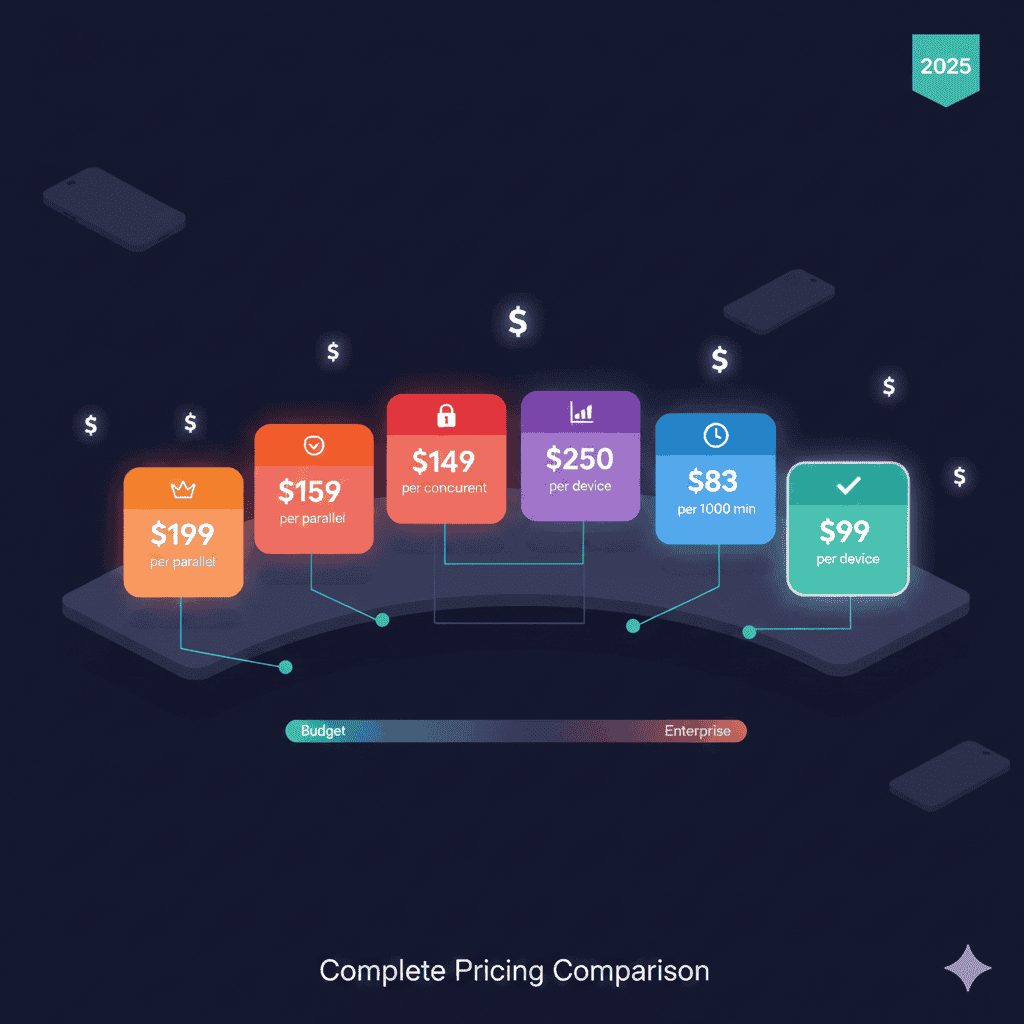
Choosing a mobile device cloud for app testing comes down to one question: how much will this actually cost?
The advertised pricing tells one story. Entry plans at $49/month, $99/month, $159/month—competitive, reasonable, budget-friendly. But the invoices tell another story entirely.
Enterprise teams report annual spend of $30,000 to $95,000. The parallel multiplication catches small teams off guard. Hidden features locked behind Pro plans force upgrades. And minute-based models create unpredictable overages.
We’ve researched pricing across BrowserStack, LambdaTest, Sauce Labs, HeadSpin, Kobiton, and AWS Device Farm. Here’s what each platform actually costs—and which pricing model works best for different team sizes.
The Quick Comparison
| Platform | Model | Entry Price | 5 Parallels | Enterprise Avg |
|---|---|---|---|---|
| BrowserStack | Per parallel | $199/mo | $995/mo | $32K/yr |
| LambdaTest | Per parallel | $159/mo | $795/mo | $15K-$20K/yr |
| Sauce Labs | Per parallel | $149/mo | ~$745/mo | $16K-$95K/yr |
| HeadSpin | Device slots | $49/mo | Custom | $42K-$48K/yr |
| Kobiton | Minutes | $83/mo | N/A | $9K-$50K/yr |
| Perfecto | Per parallel | $300/mo | Custom | $15K-$100K/yr |
| AWS Device Farm | Unlimited | $250/mo flat | $250/mo | $3K/yr |
| DeviceLab | Per device | $99/device/mo | $495/mo | Predictable |
The differences matter more than they appear. Let’s break down each platform.
BrowserStack: The Market Leader Premium
Pricing Model: Per parallel session
Entry Price: $199/month per parallel (annual)
Pro Plan: $249/month per parallel
Devices: 30,000+ real devices
BrowserStack dominates the enterprise market with the largest device cloud and most established reputation. The trade-off is price—it’s consistently the most expensive option.
What $199/parallel gets you:
- Unlimited automated testing minutes
- Access to 30,000+ real devices
- Video recordings, logs, and network insights
- CI/CD integrations
What requires the $249/parallel Pro plan:
- SIM card testing (OTP/2FA)
- Apple Pay testing
- Camera/microphone injection
- Biometric authentication
- App performance testing
The parallel math:
| Parallels | Monthly (Annual) | Annual Cost |
|---|---|---|
| 1 | $199 | $2,388 |
| 5 | $995 | $11,940 |
| 10 | $1,990 | $23,880 |
| 25 | $4,975 | $59,700 |
Enterprise reality: According to Vendr procurement data, the average BrowserStack enterprise contract is $32,433/year. Large enterprises report spending $50,000-$100,000 annually.
Best for: Enterprise teams prioritizing device coverage, reliability, and established vendor relationships over cost optimization.
Read the full analysis: BrowserStack App Automate Pricing 2025: The Parallel Tax
LambdaTest: The Budget Alternative
Pricing Model: Per parallel session
Entry Price: $159/month per parallel (annual)
HyperExecute: $159/month per license
Devices: 10,000+ real devices
LambdaTest positions itself as “BrowserStack at 30% lower cost.” The pricing is genuinely competitive, but users report trade-offs in device performance and reliability.
What $159/parallel gets you:
- Unlimited automated testing
- 10,000+ real devices
- HyperExecute (70% faster orchestration claimed)
- CI/CD integrations
The performance trade-off:
From user reviews:
“Real devices are little bit laggy. Session disconnect issue.”
“Requested iPhone 14 Pro for testing, got an emulator instead. This happens 70% of the time.”
G2 aggregated data shows 280 mentions of “slow performance” across reviews.
The parallel math:
| Parallels | Monthly (Annual) | Annual Cost | vs BrowserStack |
|---|---|---|---|
| 1 | $159 | $1,908 | 20% cheaper |
| 5 | $795 | $9,540 | 20% cheaper |
| 10 | $1,590 | $19,080 | 20% cheaper |
Hidden complexity: LambdaTest has separate products for Live testing, Real Devices, Web Automation, Native App Automation, and HyperExecute—each priced separately.
Best for: Budget-conscious startups testing on mainstream devices where performance variability is acceptable.
Read the full analysis: LambdaTest Pricing 2025: The BrowserStack Trade-Off
Sauce Labs: The Enterprise Compliance Play
Pricing Model: Per concurrent session (VDC) or parallel (RDC)
Entry Price: $149/month per concurrent
Real Device Cloud: Separate pricing
Enterprise Range: $16,000-$95,000/year
Sauce Labs is the original cloud testing platform. Today it targets regulated industries where compliance certifications matter more than price.
The concurrency trap:
Sauce Labs separates Virtual Device Cloud (VDC) and Real Device Cloud (RDC) pricing. Many teams discover they need both—and each has separate concurrency limits.
What users report:
“VDC and RDC have different concurrency limits. We bought 10 concurrent VDC and thought we could use those 10 on real devices. We couldn’t.”
“Final invoice was $43,000—we had budgeted $18,000.”
The pricing reality:
| Tier | Annual Contract | Typical Use Case |
|---|---|---|
| Team | $16,000-$25,000 | 3-5 concurrents, mixed VDC/RDC |
| Business | $25,000-$50,000 | 10+ concurrents, compliance features |
| Enterprise | $50,000-$95,000 | Unlimited, dedicated support, SOC2/HIPAA |
Best for: Enterprise teams in regulated industries (finance, healthcare) where SOC2/HIPAA compliance and audit trails justify premium pricing.
Read the full analysis: Sauce Labs Pricing 2025: The Concurrency Trap
HeadSpin: The Performance Analytics Premium
Pricing Model: Device slots (not parallels)
Entry Price: $49/month (Starter)
Reality Check: Enterprise averages $250/device/month
Enterprise Range: $42,000-$48,000/year
HeadSpin markets itself as a “Global Device Infrastructure” with AI-powered performance analytics. The $49/month Starter plan is essentially a trial—real usage costs significantly more.
The $49 vs $250 gap:
HeadSpin’s Starter plan has severe limitations:
- 600 minutes/month (10 hours)
- Limited device selection
- No AI analytics
- No automation
Teams exceeding Starter limits face enterprise pricing starting at $250/device/month.
What users actually pay:
From a VP of Engineering:
“We were quoted $48,000/year for 16 device slots. That’s $250/device/month—5x what we expected from the marketing.”
Device slot math:
| Devices | Monthly Cost | Annual Cost |
|---|---|---|
| 4 | $1,000 | $12,000 |
| 8 | $2,000 | $24,000 |
| 16 | $4,000 | $48,000 |
The differentiation: HeadSpin’s AI-powered performance analytics provide insights competitors don’t—network conditions, latency metrics, experience scores. For teams optimizing app performance (not just testing functionality), this can justify the premium.
Best for: Teams with dedicated performance engineering needs who value AI-powered insights over raw device access.
Read the full analysis: HeadSpin Pricing: The $250/Device Reality
Kobiton: The Minute-Based Wildcard
Pricing Model: Minutes consumed
Entry Price: $83/month (1,000 minutes)
Enterprise: $417-$833/month (5,000-10,000 minutes)
Risk: Unpredictable overages
Kobiton uses minute-based pricing instead of parallels. This seems simpler until test suites grow and minutes evaporate faster than expected. See our Kobiton vs BrowserStack comparison for how this affects costs at scale.
The minute consumption reality:
| Test Type | Typical Duration | Minutes/Run |
|---|---|---|
| Smoke test | 5-10 min | 5-10 |
| Regression suite | 30-60 min | 30-60 |
| Full E2E suite | 2-4 hours | 120-240 |
A team running daily regression (60 min) across 5 devices burns 9,000 minutes/month—well beyond the 5,000-minute plan.
What users report:
“We estimated 3,000 minutes monthly. Actual usage was 7,200. The overage doubled our bill.”
“Script failures consume minutes even though the test didn’t complete successfully.”
Minute plan pricing:
| Plan | Minutes | Monthly | Per Minute |
|---|---|---|---|
| Starter | 1,000 | $83 | $0.083 |
| Pro | 5,000 | $417 | $0.083 |
| Business | 10,000 | $833 | $0.083 |
| Enterprise | Unlimited | Custom | Negotiated |
Best for: Teams with predictable, low-volume testing needs who can accurately forecast minute consumption.
Read the full analysis: Kobiton Pricing 2025: When Minutes Don’t Add Up
AWS Device Farm: The Flat-Rate Outlier
Pricing Model: Unlimited monthly slot
Price: $250/month per device slot (unlimited testing)
Pay-as-you-go: $0.17/device minute
Private devices: Starting at $200/month
AWS Device Farm is the only major platform offering true flat-rate pricing. $250/month provides unlimited automated testing on one device slot—no minute caps, no overage surprises.
What $250/month gets you:
- Unlimited automated test minutes
- One device slot (one device at a time)
- Access to AWS device pool
- CI/CD integration via AWS CodePipeline
The device slot model:
Unlike parallels (which run simultaneously), AWS Device Farm’s slots determine how many devices can test at once. 5 slots = 5 devices testing simultaneously = $1,250/month.
Annual comparison:
| Slots | Monthly | Annual | vs BrowserStack 5 parallels |
|---|---|---|---|
| 1 | $250 | $3,000 | 75% cheaper |
| 5 | $1,250 | $15,000 | 25% more expensive |
| 10 | $2,500 | $30,000 | 25% more expensive |
The trade-offs:
- Smaller device selection than BrowserStack/LambdaTest
- Limited debugging tools
- No manual testing option
- AWS ecosystem lock-in
Best for: AWS-native teams with moderate device matrix needs who want predictable costs without usage tracking. For a deeper look at the 150-minute hard limit and other gotchas, see our AWS Device Farm pricing breakdown.
The Pricing Model Comparison
Each platform uses a different pricing model with different trade-offs:
Per-Parallel (BrowserStack, LambdaTest)
How it works: Pay per simultaneous test session. 5 parallels = 5 tests running at once.
Pros:
- Unlimited minutes within your parallel count
- Predictable monthly cost
- Scales with team size
Cons:
- Costs multiply linearly with parallelization needs
- Can force queuing during peak CI/CD usage
- No flexibility for burst testing
Per-Concurrent (Sauce Labs)
How it works: Similar to parallels, but often split between VDC and RDC.
Pros:
- Same as per-parallel
- Strong compliance features
Cons:
- VDC/RDC split creates complexity
- Higher base prices
- Enterprise pricing can be opaque
Per-Minute (Kobiton)
How it works: Pay for actual test execution time.
Pros:
- Lower entry cost for light usage
- Only pay for what you use
- Good for sporadic testing
Cons:
- Unpredictable monthly bills
- Failed tests still consume minutes
- Discourages thorough testing
Device-Slot (HeadSpin, AWS)
How it works: Pay for device access, often with unlimited time.
Pros:
- Predictable for heavy usage
- No minute tracking
- AWS model is true flat-rate
Cons:
- HeadSpin’s “slot” pricing reaches $250/device
- Limited device selection (AWS)
- Slot-based queuing
Per-Device (DeviceLab)
How it works: Pay per physical device connected to your account.
Pros:
- Your own hardware = consistent performance
- No parallel limits (your 5 devices = 5 parallels)
- No shared cloud variability
Cons:
- Requires physical device investment
- You manage the hardware
- Limited to devices you own
Cost Scenarios by Team Size
Solo Developer / Freelancer
Needs: Occasional testing, 1-2 devices, minimal budget
| Platform | Monthly Cost | Annual Cost |
|---|---|---|
| AWS Device Farm (PAYG) | ~$50 | ~$600 |
| HeadSpin Starter | $49 | $588 |
| Kobiton Starter | $83 | $996 |
| LambdaTest | $159 | $1,908 |
| BrowserStack | $199 | $2,388 |
Recommendation: AWS Device Farm pay-as-you-go for light usage, or LambdaTest if you need more devices.
Startup (5-10 engineers)
Needs: 3-5 parallels, daily CI/CD, mainstream devices
| Platform | Monthly Cost | Annual Cost |
|---|---|---|
| AWS Device Farm (5 slots) | $1,250 | $15,000 |
| LambdaTest (5 parallels) | $795 | $9,540 |
| BrowserStack (5 parallels) | $995 | $11,940 |
| DeviceLab (5 devices) | $495 | $5,940 |
Recommendation: LambdaTest for lowest cost, DeviceLab if performance consistency matters.
Growth Stage (20-50 engineers)
Needs: 10-15 parallels, multiple projects, diverse device matrix
| Platform | Monthly Cost | Annual Cost |
|---|---|---|
| LambdaTest (10 parallels) | $1,590 | $19,080 |
| BrowserStack (10 parallels) | $1,990 | $23,880 |
| Sauce Labs (estimated) | ~$2,500 | ~$30,000 |
| DeviceLab (10 devices) | $990 | $11,880 |
Recommendation: Evaluate based on compliance needs (Sauce Labs), device coverage (BrowserStack), or cost (LambdaTest/DeviceLab).
Enterprise (100+ engineers)
Needs: 25+ parallels, compliance, dedicated support
| Platform | Typical Annual Contract |
|---|---|
| BrowserStack Enterprise | $32,000-$60,000 |
| Sauce Labs Enterprise | $50,000-$95,000 |
| HeadSpin Enterprise | $42,000-$48,000 |
| LambdaTest Enterprise | $15,000-$25,000 |
Recommendation: Negotiate based on specific needs. BrowserStack for coverage, Sauce Labs for compliance, LambdaTest for cost savings.
The Hidden Costs Checklist
Before committing to any platform, account for these hidden costs:
1. Parallel/Concurrent Scaling
Every additional parallel multiplies your base cost. A “cheap” $149/month plan becomes $1,490/month at 10 parallels. We break down this cost escalation in detail in our parallel slot tax analysis.
2. Pro Plan Features
Advanced features like OTP testing, biometric simulation, or camera injection often require 20-25% premium plans.
3. VDC/RDC Split
On Sauce Labs, virtual device and real device concurrency are separate pools—you may need to buy both.
4. Minute Overages
Kobiton’s minute-based model can create unpredictable overages when test suites grow.
5. Annual Lock-In
Most advertised prices require annual commitment. Monthly rates are typically 20-40% higher.
6. Enterprise-Only Features
Features like SSO, priority support, dedicated devices, and SLAs often require enterprise conversations.
7. Performance Costs
Slow tests on laggy cloud devices consume more time and engineer attention—a hidden cost that doesn’t appear on invoices. Shared cloud infrastructure also increases flaky test rates, which cost enterprises $1.14 million per year in developer time and delayed releases.
The Alternative: Test on Your Own Devices
Every cloud pricing model shares one fundamental trade-off: you’re renting access to hardware someone else controls. Performance, availability, and device behavior are variables outside your control.
DeviceLab inverts this model:
$99/device/month connects your physical devices to a globally accessible testing cloud. No shared infrastructure. No performance lottery. No parallel limits.
The math for 5-device testing:
| Platform | Model | Monthly | Annual |
|---|---|---|---|
| BrowserStack | 5 parallels | $995 | $11,940 |
| LambdaTest | 5 parallels | $795 | $9,540 |
| Sauce Labs | 5 concurrent | ~$1,200 | ~$14,400 |
| AWS Device Farm | 5 slots | $1,250 | $15,000 |
| DeviceLab | 5 devices | $495 | $5,940 |
Your iPhone 14 Pro is actually an iPhone 14 Pro—not an emulator, not a shared device, not a cloud instance with unpredictable performance.
Quick Decision Framework
Choose BrowserStack if:
- Device coverage is your top priority (30,000+ devices)
- Enterprise procurement prefers established vendors
- You need the largest selection of legacy/regional devices
- Budget is secondary to reliability
Choose LambdaTest if:
- Cost savings matter more than device coverage
- HyperExecute speed aligns with your CI/CD needs
- You primarily test on mainstream devices
- Performance variability is acceptable
Choose Sauce Labs if:
- Compliance certifications are required (SOC2, HIPAA)
- You’re in a regulated industry
- Strong analytics and reporting matter
- Budget is $30,000+ annually
Choose HeadSpin if:
- Performance analytics are your primary use case
- You have dedicated performance engineering resources
- Global carrier/network testing is critical
- Budget is $40,000+ annually
Choose Kobiton if:
- Your testing volume is predictable and low
- You can accurately forecast minute consumption
- Scriptless testing appeals to your team
- You want to avoid parallel-based pricing
Choose AWS Device Farm if:
- You’re AWS-native and want ecosystem integration
- Flat-rate pricing matters more than device selection
- Your device matrix is modest
- Predictability beats flexibility
Choose DeviceLab if:
- Performance consistency is non-negotiable
- You want to test on your actual production devices
- Parallel limits frustrate your CI/CD pipeline
- You prefer predictable per-device costs
The Bottom Line
Mobile device cloud pricing in 2025 follows a clear pattern: entry prices are competitive, but costs multiply quickly as teams scale.
The platform that looks cheapest at 1 parallel may not be cheapest at 10. The “unlimited” plan may have separate pools for virtual and real devices. The minute-based model that seems flexible may create budget surprises.
Before choosing a platform:
- Calculate your actual parallel/concurrent needs — not today, but 12 months from now (our device cloud cost calculator can help)
- Identify required features — OTP testing, biometric simulation, and camera injection often require Pro plans
- Understand the pricing model — per-parallel, per-minute, per-slot, and per-device have different scaling characteristics
- Account for performance costs — slow cloud devices waste engineer time even if they’re cheaper per-parallel
- Consider alternatives — testing on your own devices eliminates the parallel multiplication problem entirely
The best mobile device cloud isn’t the one with the lowest entry price. It’s the one whose pricing model matches how your team actually tests.
Frequently Asked Questions
What is the cheapest mobile device cloud for app testing?
AWS Device Farm offers the lowest absolute cost at $250/month flat for unlimited automated testing on one device slot. For parallel-based testing, LambdaTest starts at $159/parallel versus BrowserStack’s $199/parallel—roughly 20% cheaper. However, the cheapest option depends on usage patterns: Kobiton’s minute-based pricing can be cheaper for light usage, while DeviceLab’s $99/device/month model eliminates parallel costs entirely for teams with their own hardware.
How much does BrowserStack App Automate cost in 2025?
BrowserStack App Automate costs $199/month per parallel for Device Cloud (billed annually), or $249/month per parallel for Device Cloud Pro with advanced features like OTP testing, Apple Pay, and biometric simulation. At 5 parallels, this equals $995-$1,245/month ($11,940-$14,940/year). Enterprise contracts average $32,433/year according to Vendr procurement data, with large enterprises spending $50,000-$100,000 annually for 25+ parallels and dedicated support.
Is LambdaTest cheaper than BrowserStack?
Yes, LambdaTest typically costs 20-30% less than BrowserStack for equivalent parallel counts. LambdaTest native app automation is $159/parallel versus BrowserStack’s $199/parallel. At 5 parallels, LambdaTest saves approximately $2,400/year. However, BrowserStack offers 3x more devices (30,000+ versus 10,000+), and users consistently report fewer performance issues with BrowserStack. The savings may be offset by slower test execution and reliability concerns.
What are the hidden costs of mobile device cloud platforms?
Common hidden costs include: (1) parallel scaling—5 parallels can cost $800-$1,200/month, not the $150-$200 entry price, (2) Pro plan upgrades—advanced features like OTP testing require 20-25% premium plans, (3) VDC/RDC split—Sauce Labs charges separately for virtual and real device concurrency, (4) minute overages—Kobiton’s model creates unpredictable costs when test suites grow, (5) annual lock-in—monthly rates are 20-40% higher than advertised annual rates, and (6) enterprise features—SSO, SLAs, and priority support require sales conversations.
Last updated: December 2025. Pricing verified from official websites and user reports.
See how DeviceLab compares to the giants: vs BrowserStack | vs Sauce Labs | Read the Cost Analysis →