
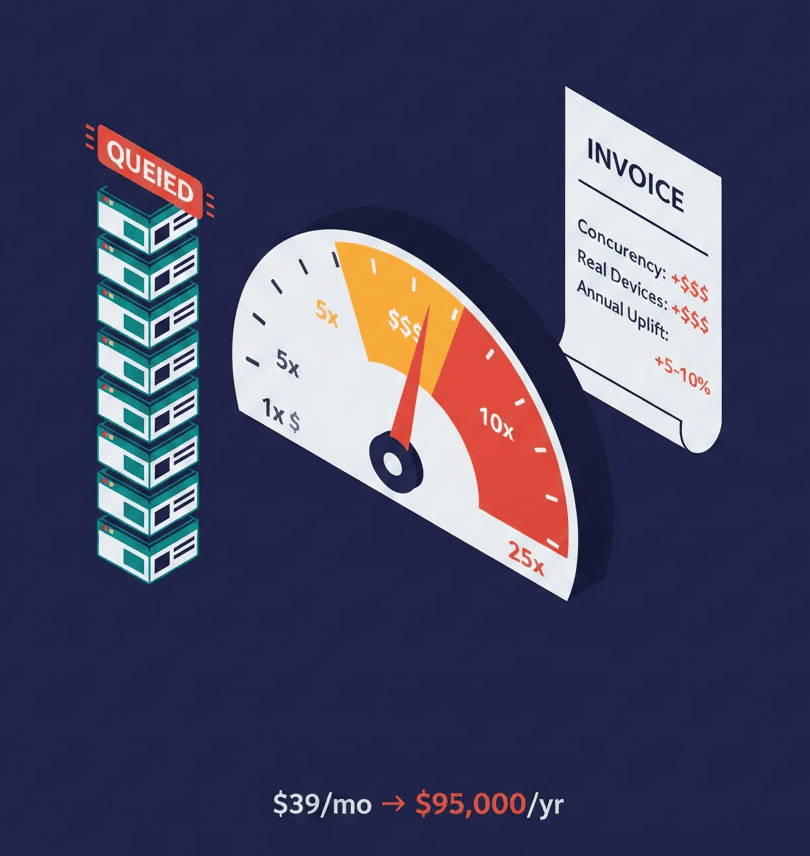
Sauce Labs pricing looks straightforward at first glance. Live Testing starts at $39/month. Virtual Cloud at $149/month. Real Device Cloud at $199/month.
But those prices buy you exactly one parallel test.
Need to run 10 tests simultaneously? Multiply by 10. Need 25 concurrent sessions for your CI/CD pipeline? That’s enterprise pricing territory—and users report paying $16,000 to $95,000 per year.
Welcome to the concurrency trap.
The Advertised Pricing vs. Reality
Here’s what Sauce Labs’ pricing page shows:
| Plan | Monthly | Annual (per month) |
|---|---|---|
| Live Testing | $49 | $39 |
| Virtual Cloud | $199 | $149 |
| Real Device Cloud | $249 | $199 |
Looks competitive with BrowserStack and LambdaTest, right?
The catch: each plan includes 1 parallel test. The price scales with concurrency—1 to 24 concurrent sessions for credit card plans, custom pricing beyond that.
Real Device Cloud and Virtual Cloud are separate products with separate concurrency limits. Need both? Pay for both.
What Enterprises Actually Pay
Procurement data from Vendr reveals what companies actually spend on Sauce Labs:
| Company Size | Annual Cost Range |
|---|---|
| ~200 employees | $16,000 - $38,900 |
| ~1,000 employees | $23,800 - $49,700 |
| 1,000+ employees | $43,000 - $95,100 |
One QA engineer on PeerSpot shared specifics:
“It might range from $24,000 to $70,000. We have more than 60 to 70 VMs, so the cost is on the higher side.”
For context, that’s roughly $400-$1,000 per VM per year—or $33-$83 per VM per month at scale. Not outrageous, but far from the $149/month advertised rate.
The Concurrency Multiplication Problem
Sauce Labs’ pricing model creates a specific challenge for growing teams.
From their documentation: “Your subscription to the Sauce Labs Virtual Cloud or Real Device Cloud entitles you to run a certain amount of concurrent tests… If your organization attempts to run more tests than your subscription permits then your tests will be queued.”
The implications:
Test queuing slows feedback. When you exceed concurrency, tests queue for up to 15-30 minutes before timing out with errors.
Concurrency is shared across your organization. If Team A uses 5 of your 10 slots, Team B only gets 5—even if they have separate budgets.
Real devices have separate limits. Your Virtual Cloud concurrency doesn’t apply to Real Device Cloud. Two pools, two costs.
A TrustRadius reviewer explained the pain:
“Currently, our test suite takes over three hours to run and at the moment it is cost prohibitive to purchase an extra slot.”
The economics create a ceiling: teams hit concurrency limits, face pressure to upgrade, but find the incremental cost hard to justify.
The 5-10% Annual Price Increase
Unlike competitors with stable pricing, Sauce Labs implements regular increases.
From Vendr community insights:
“Sauce is increasing pricing over the next year and it is typically a 5-10% uplift.”
For a company paying $50,000/year, that’s $2,500-$5,000 annually in automatic increases—compounding year over year.
Multi-year agreements can lock in rates, but they reduce flexibility. One user secured a 23% discount through a multi-year commitment. Others report 15-38% discounts by threatening to switch to BrowserStack.
The Upselling Machine
The most damaging complaints involve post-sale behavior.
A Capterra review (zero stars) captures the experience:
“The worst experience ever! Never recommend. Do not provide service which was paid for, even on yearly enterprise subscription. Once you pay for yearly subscription, they only interested you to buy additional services and do not fix your issues for ages. Support manager is only for marketing, aggressively push you to buy unnecessary services and increase fees. BrowserStack is much much much better.”
This pattern appears across review platforms:
PeerSpot: “They might be providing too many things in the package, and all of them might not be useful for people. They can modularize the offering instead of giving it as a whole package.”
Vendr: “Taxes and extra fees may apply… adding user seats mid-term is possible with Sauce Labs, although they might not be pro-rated.”
The bundled approach means paying for features you don’t use, with add-ons for features you need.
Performance Issues Despite Premium Pricing
At enterprise rates, you’d expect premium performance. Users report otherwise.
Latency is inherent to the architecture. Sauce Labs’ own documentation acknowledges:
“It’s a reality that tests run on Sauce Labs will always have some latency, compared to running locally, due to there being an Internet in the middle between your tests and our browsers.”
Capterra users detail the impact:
“The tests execution is several times slower when using Sauce Labs.”
“The real device options are insanely slow and make for a very jittery experience.”
PeerSpot feedback:
“Latency, due to Sauce Labs being a cloud-based solution, has been a concern. We work in different continents and countries… there is some noticeable latency.”
For teams outside the US and EU, the problem compounds. Sauce Labs operates data centers in US West, US East, and EU Central. Testing from Asia, South America, or Africa means additional latency.
For a detailed analysis of Sauce Connect’s network issues, see our breakdown of the TCP meltdown problem.
The Real Device Premium
Real device testing carries particular cost pressure.
Historical context: When Sauce Labs launched Real Device Cloud in 2015, pricing started at $449 per device per month.
Current pricing is more accessible ($199-$249/month for entry), but the pattern persists:
Vendr insight: “We have been with Sauce Labs for a few years. While we enjoy the platform and features, the cost for real devices is very high. BrowserStack offered very competitive pricing for real devices which piqued our interest in a transition to their product.”
Private devices (dedicated hardware for your organization) command additional premiums—pricing available only through sales.
Where the Money Actually Goes
Understanding Sauce Labs’ cost structure helps explain the pricing:
Infrastructure costs: Maintaining thousands of devices, VMs, and browser combinations across multiple data centers requires significant capital.
Acquisition integration: Sauce Labs acquired TestObject (mobile testing), Screener (visual testing), and Backtrace (error reporting). Each adds capability—and cost to recoup.
Enterprise sales motion: The model depends on land-and-expand. Low entry prices attract teams; concurrency limits and feature gaps drive upgrades.
This isn’t inherently problematic—it’s how enterprise software works. The friction comes when the sales motion conflicts with customer experience.
Competitor Pricing Comparison
How does Sauce Labs stack up?
| Platform | Entry Price | Real Devices | Concurrency Model | Enterprise Est. |
|---|---|---|---|---|
| Sauce Labs | $39/mo | Separate ($199/mo) | Per parallel test | $16K-$95K/yr |
| BrowserStack | $39/mo | Included | Per parallel test | $2.4K-$10K/yr |
| LambdaTest | $15/mo | Included | Per parallel test | $1.8K-$6K/yr |
| HeadSpin | $49/mo | Included | Per device slot | $42K-$48K/yr |
| DeviceLab | $99/device/mo | Your devices | Per device | Predictable |
Key differences:
BrowserStack and LambdaTest include real devices in their base plans. Sauce Labs charges separately.
HeadSpin costs more than Sauce Labs but includes AI analytics and global carrier testing—though with its own pricing challenges. For a comparison with BrowserStack, see BrowserStack pricing.
DeviceLab inverts the model entirely: instead of renting concurrency on cloud devices, you connect your own devices at a flat per-device rate.
For detailed cost modeling, see our device cloud cost calculator.
When Sauce Labs Makes Sense
Despite the cost structure, Sauce Labs delivers value in specific scenarios:
Massive browser/OS matrix testing. If you need to test across 800+ browser/OS combinations, Sauce Labs’ infrastructure is hard to replicate.
Existing Selenium/Appium investments. Teams with mature test suites benefit from Sauce Labs’ framework support and integration ecosystem.
Shared licensing models. Unlike per-user pricing, Sauce Labs’ shared concurrency works well for organizations with mixed usage patterns (heavy and light users).
Enterprise compliance requirements. SOC 2 Type II, ISO 27001, and ISO 27701 certifications matter for regulated industries.
Negotiation leverage. If you’re willing to commit to multi-year agreements or leverage BrowserStack quotes, discounts of 20-38% are achievable.
When Sauce Labs Doesn’t Make Sense
Teams scaling parallel execution. If your CI/CD pipeline needs 20+ concurrent tests, the cost multiplication becomes prohibitive fast.
Budget-conscious organizations. At $16,000-$95,000/year, Sauce Labs exceeds what many mid-market companies allocate for testing infrastructure.
Privacy-sensitive applications. All test data flows through Sauce Labs’ cloud. For regulated industries or security-conscious teams, this creates compliance overhead.
Teams outside US/EU. Latency from Asia, South America, or Africa degrades the testing experience despite premium pricing.
Organizations frustrated by upselling. If the post-sale experience matters, user reviews suggest friction ahead.
Negotiation Strategies
If you’re committed to Sauce Labs, these tactics help:
Get competitive quotes first. Vendr users report: “We were able to achieve a 38% discount on our renewal by positioning BrowserStack as a strong competitor.”
Leverage multi-year commitments. “We secured a 23% discount by leveraging a multi-year agreement.”
Bundle for discounts. “They were very competitive on pricing and provided a bundle discount for us as a larger customer.”
Request implementation fee removal. Per Vendr: “The implementation fee for the application can potentially be removed.”
Time renewals strategically. “As we approached the last few months of our agreement with Sauce Labs we noted that we had significant growth. We were able to leverage our growth and an early renewal to secure a ~22.5% discount.”
The Alternative: Test on Your Own Devices
The fundamental tension with cloud testing platforms—Sauce Labs included—is architectural. You’re renting access to someone else’s devices, paying for concurrency you might not fully use, subject to network latency you can’t eliminate.
DeviceLab inverts this model:
$99/device/month. Not per concurrent test—per device. Your devices, your network, your data.
No concurrency multiplication. Add devices as needed. Each device is a dedicated testing resource.
Zero cloud latency. Tests run on local devices with local network speeds.
No upselling. Flat pricing without enterprise “contact sales” gates.
For a team running 16 devices:
- Sauce Labs Real Device Cloud: $16,000-$38,000/year (based on Vendr ranges)
- DeviceLab: $19,008/year
The savings fund additional devices, better hardware, or simply healthier margins.
Quick Checklist: Is Sauce Labs Right for You?
Consider Sauce Labs if:
- You need 800+ browser/OS combinations
- Your Selenium/Appium test suite is mature
- You can negotiate enterprise pricing effectively
- Shared licensing fits your usage patterns
- You’re in US or EU (minimal latency impact)
Consider alternatives if:
- Parallel test scaling drives cost multiplication
- Your budget targets <$10,000/year
- Data privacy requires on-premise solutions
- You’re outside US/EU data center regions
- Post-sale experience and support matter significantly
See the full comparison: Mobile Device Cloud Pricing 2025. Also compare Sauce Labs vs LambdaTest and Sauce Labs vs Perfecto for competitor pricing. Looking to switch? Check out Sauce Labs alternatives.
The Bottom Line
Sauce Labs isn’t overpriced for what it delivers—massive infrastructure, broad framework support, enterprise compliance. The friction comes from how it’s sold: entry pricing that obscures concurrency costs, annual increases of 5-10%, and upselling that frustrates customers after they’ve committed.
For teams with negotiation leverage and enterprise budgets, Sauce Labs remains a credible choice. For everyone else, the math increasingly favors alternatives that don’t multiply costs with every parallel test.
Before signing a multi-year agreement, calculate your true concurrency needs. Then multiply. The number that emerges is closer to what you’ll actually pay.
Frequently Asked Questions
How much does Sauce Labs cost?
Entry pricing starts at $39/month for Live Testing (1 parallel test, billed annually). Virtual Cloud costs $149/month and Real Device Cloud $199/month—each for single concurrent sessions. Enterprise customers report paying $16,000-$95,000/year depending on team size, concurrency requirements, and negotiated discounts. Prices scale with parallel test capacity.
Why is Sauce Labs so expensive?
Sauce Labs uses concurrency-based pricing where costs multiply with each parallel test slot. Entry prices appear competitive, but running 10 concurrent tests means 10x the base cost. Real device testing is priced separately from virtual cloud testing. Users report 5-10% annual price increases and aggressive upselling after signing enterprise contracts.
Is Sauce Labs worth the price?
For large enterprises with existing Selenium/Appium investments needing massive browser coverage, Sauce Labs delivers value—especially with negotiated discounts of 20-38%. However, users report inherent latency, support issues after signing, and “cost prohibitive” fees for additional concurrency. Teams with budget constraints or scaling needs often find better value elsewhere.
What are cheaper alternatives to Sauce Labs?
BrowserStack starts at $39/month with real devices included in base plans. LambdaTest starts at $15/month with similar capabilities. DeviceLab offers $99/device/month for testing on your own devices with zero cloud latency and no concurrency multiplication. All support Appium and Selenium without Sauce Labs’ tiered pricing structure.
Last verified: December 2025. Pricing from official sources and Vendr procurement data.
See how DeviceLab compares to the giants: vs BrowserStack | vs Sauce Labs | Read the Cost Analysis →