
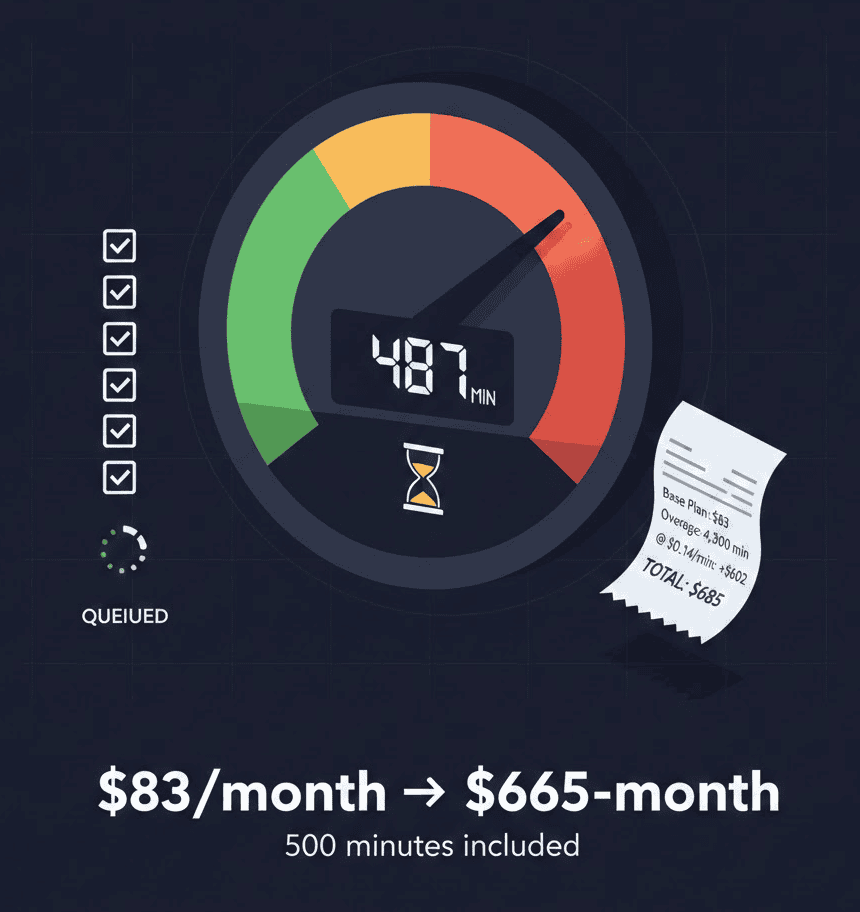
Kobiton pricing looks straightforward. Startup plan at $83/month. Accelerate at $399/month. Scale at $9,000/year.
Then you read the fine print: those prices buy you minutes, not unlimited access.
The Startup plan includes 500 minutes per month. That’s 8.3 hours of testing. For a CI/CD pipeline running 4 hours of automated tests daily, you’ll exhaust your monthly allocation by day two.
Welcome to minute-based pricing—where the more you automate, the less predictable your costs become. The per-minute model creates anxiety for teams running CI/CD pipelines. See our complete Kobiton alternatives analysis for platforms with different pricing approaches.
The Official Pricing
Here’s what Kobiton’s pricing page shows:
| Plan | Price | Minutes/Month | Overage Rate |
|---|---|---|---|
| Startup | $83/mo | 500 | $0.14/min |
| Accelerate | $399/mo | 3,000 | $0.10/min |
| Scale | $9,000/yr | 7,500 | Custom |
| Enterprise | Contact sales | Custom | Custom |
The entry price appears competitive. $83/month is less than BrowserStack’s $129/month automation plan and far less than Sauce Labs’ enterprise pricing. How does Kobiton stack up against the market leader? See our Kobiton vs BrowserStack comparison with G2 ratings and real user reviews.
But the comparison breaks down when you understand what “500 minutes” actually means for a working QA team.
The Minute Math Problem
Let’s calculate what different testing scenarios actually cost.
Scenario 1: Light Manual Testing
- 30 minutes/day, 20 days/month
- Total: 600 minutes
- Startup plan: $83 + (100 min × $0.14) = $97/month
This works. Kobiton delivers value here.
Scenario 2: Basic Automation
- 2-hour test suite, once daily
- Total: 2,400 minutes/month
- Startup plan: $83 + (1,900 min × $0.14) = $349/month
- Accelerate plan: $399 (no overage)
You’re forced into the Accelerate plan or paying equivalent overages.
Scenario 3: CI/CD Pipeline
- 4-hour test suite, twice daily (commit + nightly)
- Total: 9,600 minutes/month
- Accelerate plan: $399 + (6,600 min × $0.10) = $1,059/month
- Scale plan: $750/mo ($9,000/yr) + (2,100 min × custom rate)
Even the Scale plan’s 7,500 minutes doesn’t cover serious automation.
Scenario 4: Parallel Execution
- 4-hour suite across 5 devices simultaneously
- Total: 24,000 minutes/month
- Scale plan: $750/mo + 16,500 minutes overage
At this point, you’re deep into Enterprise territory—and “contact sales” pricing.
The Overage Trap
Kobiton’s support documentation explains the overage model:
“To minimize disruption to your operation, we allow you to continue testing even after you’ve exceeded the testing minutes allotted in your plan. However, these minutes are charged at a slightly higher price.”
“Slightly higher” is $0.14/minute on Startup and $0.10/minute on Accelerate. Here’s what that means in practice:
| Overage Amount | Startup Cost | Accelerate Cost |
|---|---|---|
| 500 minutes | $70 | $50 |
| 1,000 minutes | $140 | $100 |
| 2,500 minutes | $350 | $250 |
| 5,000 minutes | $700 | $500 |
A team that underestimates their usage by 2,500 minutes pays an extra $250-$350—potentially doubling their monthly bill.
The documentation recommends purchasing “add-on minutes” to avoid overage rates, but this requires predicting usage accurately. Flaky tests that retry, longer-than-expected test runs, and debugging sessions all consume minutes unpredictably.
The Device Reliability Problem
Minute-based pricing would be tolerable if every minute delivered value. But users report significant reliability issues with Kobiton’s shared device cloud.
From InfoTech/SoftwareReviews:
“Historically the thing I’ve disliked the most about Kobiton is the inconsistent connectivity of its devices. I have experienced all too many instances in which shared devices either have poor connections that make interaction very slow or are just unable to connect at all.”
The same reviewer offers a damning recommendation:
“If you’re intending to run automated tests on Kobiton devices, seriously consider investing in dedicated devices. When we attempted to run Katalon tests on Kobiton’s shared devices, the connections were so inconsistent that we always had more failures than passes. In the end it wasn’t worth our time.”
This creates a compounding problem: unreliable devices cause test failures, which trigger retries, which consume more minutes, which increase costs. For fixes to these issues, see our Kobiton troubleshooting guide.
From Capterra:
“At times, some public cloud devices will not be healthy (no memory, no network, etc) which will fail the tests randomly.”
“It can be quite buggy or slow sometimes.”
“It’s very slow, and the UI can be clumsy at times.”
From AWS Marketplace reviews:
“It could be slow at times in terms of the speed and connectivity. The devices continuously needs to be plugged in so reducing their battery life.”
When you’re paying by the minute, slow devices cost real money.
The Enterprise Feature Lock-In
Kobiton’s self-serve plans exclude several features that enterprises typically need:
Local Device Connection: Want to connect your own devices to Kobiton’s platform? Enterprise only.
Private Dedicated Devices: Need devices exclusively for your organization? Enterprise only.
On-Premises Deployment: Require air-gapped or fully on-prem testing? Enterprise only.
Advanced Analytics: Deep reporting beyond basic test results? Enterprise only.
From Kobiton’s support documentation:
“Local device slots are not offered in our self-service packages. You’ll need to contact our Enterprise sales team to discuss custom packaging.”
“Private devices are not offered in our self-service packages. You’ll need to contact our Enterprise sales team to discuss custom packaging.”
This creates a progression where teams start on self-serve plans, hit feature limitations, and must negotiate enterprise contracts to continue scaling.
iOS-Specific Pain Points
iOS testing on Kobiton introduces additional friction:
From Capterra:
“When I use iOS devices it usually requires me to log into my apple ID to download apps from the app store. Not sure if that is something Kobiton could fix or if it’s normal iOS behavior.”
“I also noticed sometimes I cannot even get into the store. It will ask for a pattern code to be entered (I assume this is security set up by Kobiton to prevent tampering with settings and such but this should not block the App Store but it does on some devices).”
These iOS limitations aren’t unique to Kobiton—Apple’s restrictions affect all cloud device providers. But they compound the reliability issues and minute wastage.
The Data Retention Catch
Kobiton’s Startup plan has another limitation buried in the documentation:
“For most plans, historical data from your test sessions is stored for 1 year from the date of execution. However, we only keep your data for 90 days in the Start up package.”
Teams on the entry plan lose access to test history after 90 days. For compliance-sensitive organizations or teams debugging intermittent issues, this creates pressure to upgrade.
What Users Actually Like
To be fair, Kobiton has genuine strengths that users acknowledge.
From Capterra:
“Faster app releases; more detailed defect data; speed of testing; much less expensive than AWS and Perfecto”
“At first Kobiton just looks like a cheaper/faster version of AWS device farm.”
“Comparing the platforms, I found Kobiton to be the easiest to get started. It’s one of the few where you can just sign up for a trial and get started right away.”
“Cost was a major factor for us to decide the provider.”
From G2:
“Kobiton is very easy to use and it has a very easy way to integrate with automation frameworks. We can easily access mobile phones with a UI.”
The value proposition is real: Kobiton costs less than Perfecto and AWS Device Farm for equivalent functionality. The question is whether minute-based pricing maintains that advantage as usage scales.
Competitor Pricing Comparison
How does Kobiton compare to alternatives?
| Platform | Model | Entry Price | Real Devices | Enterprise Est. |
|---|---|---|---|---|
| Kobiton | Minutes | $83/mo (500 min) | Shared cloud | $9K-$50K+/yr |
| BrowserStack | Concurrency | $39/mo | Included | $2.4K-$10K/yr |
| Sauce Labs | Concurrency | $39/mo | Separate tier | $16K-$95K/yr |
| LambdaTest | Concurrency | $15/mo | Included | $1.8K-$6K/yr |
| HeadSpin | Device slots | $49/mo | Included | $42K-$48K/yr |
| Perfecto | Per parallel | $300/mo | Included | $15K-$100K/yr |
| DeviceLab | Per device | $99/device/mo | Your devices | Predictable |
Key differences:
BrowserStack and LambdaTest use concurrency-based pricing. You pay for parallel test capacity, not minutes consumed. More predictable for automation-heavy teams.
Sauce Labs also uses concurrency but separates real devices into a higher tier—similar complexity to Kobiton’s Enterprise features.
HeadSpin charges per device slot with unlimited usage. Higher base cost but no minute tracking.
DeviceLab inverts the model entirely: $99/device/month for your own hardware, unlimited testing time, no cloud dependency.
When Kobiton Makes Sense
Despite the pricing complexity, Kobiton delivers value in specific scenarios:
Manual testing teams: If your primary use case is occasional device checks and exploratory testing, 500-3,000 minutes/month may be sufficient.
Compared to Perfecto/AWS: Users consistently note Kobiton costs less than these enterprise alternatives. If you’re comparing against $50K+ Perfecto contracts, Kobiton’s pricing looks attractive.
Easy onboarding: The free trial requires no credit card, and self-serve plans let teams start immediately without sales cycles.
AI features on Enterprise: Kobiton’s scriptless automation and self-healing Appium capabilities add value for teams that qualify for Enterprise pricing.
SOC 2 Type 2 compliance: Kobiton maintains SOC 2 Type 2 and ISO 27001 certifications, meeting enterprise security requirements.
When Kobiton Doesn’t Make Sense
CI/CD automation at scale: Minute-based pricing punishes exactly the behavior modern teams want—frequent, comprehensive automated testing.
Unpredictable workloads: If your testing volume varies significantly, budgeting becomes difficult. A release crunch that doubles test runs also doubles costs.
Teams needing device reliability: Multiple reviewers report connectivity issues and “unhealthy” shared devices. If test stability matters, the shared cloud introduces risk.
Organizations wanting transparent pricing: Enterprise features require sales conversations. Local devices, private hardware, and on-prem deployment aren’t available self-serve.
Teams outside US/EU: Like other cloud providers, latency increases for teams in Asia, South America, or Africa.
The Alternative: Test on Your Own Devices
The fundamental tension with minute-based pricing is that it creates a tax on automation maturity. The more you test, the more you pay—with no ceiling.
DeviceLab inverts this model:
$99/device/month: Flat rate per device, unlimited testing time. No minutes to track, no overages to surprise you.
Your devices, your network: Tests run on hardware you control, eliminating “unhealthy device” problems.
Zero minute anxiety: Run your test suite 10 times a day without watching a meter.
No enterprise lock-in: Local devices work on every plan. No “contact sales” for basic functionality.
For a team needing 10,000 minutes/month (use our device cloud cost calculator to estimate your usage):
- Kobiton Accelerate: $399 + (7,000 × $0.10) = $1,099/month
- DeviceLab (5 devices): $495/month, unlimited minutes
The savings compound as automation scales.
Quick Checklist: Is Kobiton Right for You?
Consider Kobiton if:
- Your testing is primarily manual or light automation
- You need <3,000 minutes/month reliably
- You’re comparing against higher-cost alternatives like Perfecto
- You value easy onboarding without sales cycles
- Your security requirements need SOC 2 Type 2 compliance
Consider alternatives if:
- Your CI/CD pipeline runs tests continuously
- You need predictable monthly costs
- Device reliability is critical to your workflow
- You want self-serve access to advanced features
- Minute tracking creates anxiety for your team
See the full comparison: Mobile Device Cloud Pricing 2025
The Bottom Line
Kobiton isn’t overpriced for what it delivers—real device testing, AI features, and solid integrations. The friction comes from minute-based pricing that becomes unpredictable at scale.
For manual testing and light automation, Kobiton’s entry plans offer genuine value. For CI/CD-integrated teams running thousands of test minutes monthly, the model starts working against you.
Before committing, calculate your actual monthly minute consumption. Include retries, parallel execution, and debugging sessions. The number that emerges is closer to what you’ll actually pay.
If that number exceeds 7,500 minutes, you’re in Enterprise territory—where “contact sales” replaces transparent pricing.
Frequently Asked Questions
How much does Kobiton cost in 2025?
Kobiton offers four pricing tiers: Startup at $83/month (500 minutes), Accelerate at $399/month (3,000 minutes), Scale at $9,000/year (7,500 minutes/month), and Enterprise with custom pricing. Overage minutes cost $0.14/minute on Startup and $0.10/minute on Accelerate. Enterprise pricing requires contacting sales and typically ranges from $20,000-$50,000+ annually depending on usage and features.
Why is Kobiton pricing based on minutes?
Kobiton uses minute-based pricing to charge for actual testing time rather than infrastructure capacity. This appears flexible—you pay only for what you use. However, it creates unpredictable costs for automation-heavy teams. A 4-hour daily test suite consumes 4,800 minutes monthly, nearly 10x the Startup plan’s 500-minute allocation. Minute tracking also penalizes test retries and debugging sessions.
Is Kobiton cheaper than BrowserStack?
For light manual testing, yes—Kobiton’s $83/month undercuts BrowserStack’s pricing. But for CI/CD automation, the comparison flips. BrowserStack’s concurrency-based model charges for parallel test capacity with unlimited usage, while Kobiton charges per minute consumed. A team needing 5,000 minutes/month pays approximately $349-$599 on Kobiton (depending on plan), while BrowserStack’s automation pricing remains flat regardless of test duration.
What are alternatives to Kobiton?
BrowserStack ($39/month) and Sauce Labs ($39/month) offer concurrency-based pricing with unlimited test duration. LambdaTest starts at $15/month with similar capabilities. HeadSpin ($49/month) uses device slot pricing. DeviceLab offers $99/device/month for unlimited testing on your own devices—no minute tracking, no overage charges, no cloud latency. Each model suits different use cases depending on whether predictable costs or flexibility matters more.
Last verified: December 2025. Pricing from official sources and user reviews.
See how DeviceLab compares to the giants: vs BrowserStack | vs Sauce Labs | Read the Cost Analysis →